 Pepe
Pepe
Pepe liquidity influences the price impact and cost of larger trades
Pepe liquidity describes how readily PEPE can be bought or sold without a large change in its execution price. The relevant measure is the depth available for the intended trade size and direction. A sale needs buying interest or pool reserves of the receiving asset. Deeper accessible liquidity generally reduces price impact, while fees and intervening market moves also affect proceeds.
Liquidity belongs to particular markets and pools. A headline price or combined volume figure cannot tell you how a larger order will fill. The useful question is how much trading capacity lies along that order's actual path.
In short: A larger PEPE trade needs depth across its execution path, so the best displayed price may cover only part of the quantity.
Preparing a PEPE Sale With Defined Price Limits
A planned PEPE sale starts with a fixed token quantity and an acceptable minimum amount of the receiving asset. An exchange sell limit sets a minimum price per token, but a partial fill can leave total proceeds below the required amount. A compatible swap's minimum-output condition sets a floor for the amount received. Both controls require enough accessible liquidity for execution within their bounds.
- Confirm the intended PEPE market and asset identity; on Ethereum, match the token's contract address.
- Compare the full sale quantity with available bids or a swap quote for that exact input.
- Identify fees already included in the quote and charges payable separately.
- Use the supported price limit or minimum output to bound acceptable execution.
- Keep the sale unsubmitted if its permitted proceeds fall below the required amount.
If the prepared terms are acceptable, submit through the market's supported order or swap method. Execution exchanges the filled PEPE quantity for the receiving asset, subject to fees. Reconcile the filled quantity, credited proceeds, and remaining tokens against the execution record. A submission message alone does not confirm a completed sale.
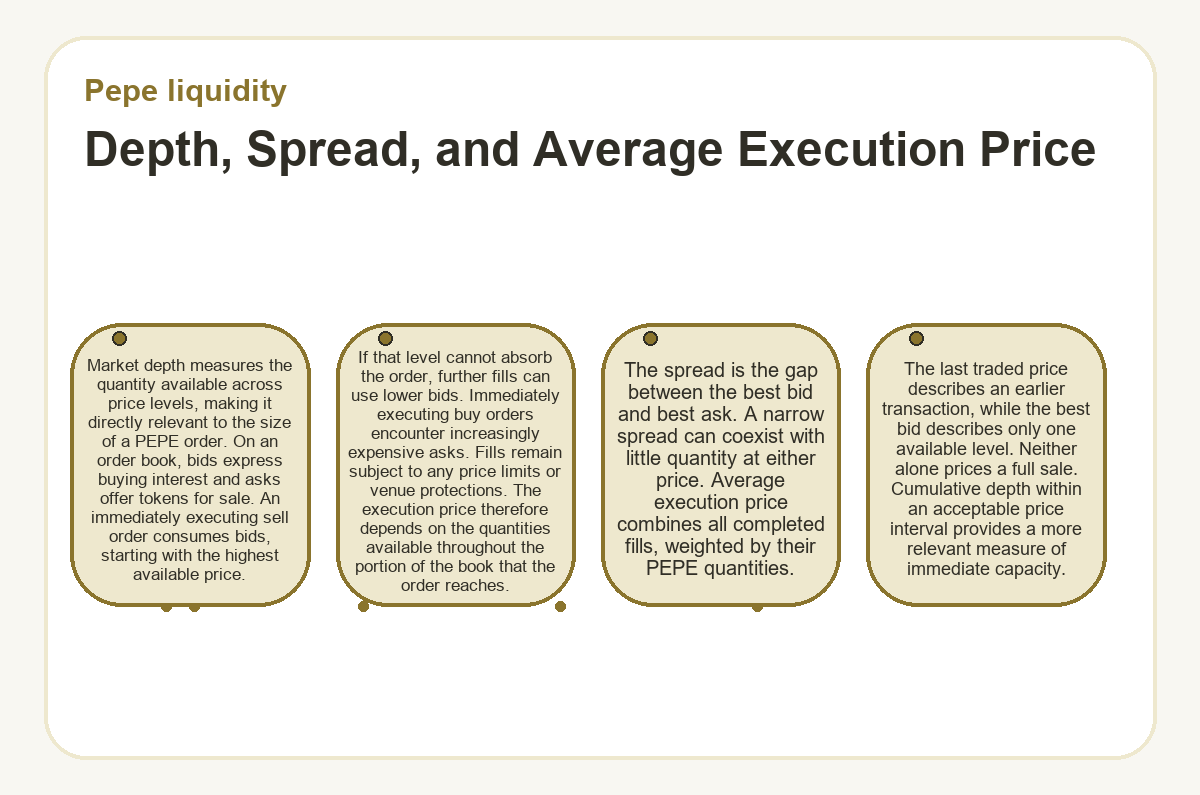
Depth, Spread, and Average Execution Price
Market depth measures the quantity available across price levels, making it directly relevant to the size of a PEPE order. On an order book, bids express buying interest and asks offer tokens for sale. An immediately executing sell order consumes bids, starting with the highest available price. If that level cannot absorb the order, further fills can use lower bids. Immediately executing buy orders encounter increasingly expensive asks. Fills remain subject to any price limits or venue protections. The execution price therefore depends on the quantities available throughout the portion of the book that the order reaches.
The spread is the gap between the best bid and best ask. A narrow spread can coexist with little quantity at either price.
Average execution price combines all completed fills, weighted by their PEPE quantities. The last traded price describes an earlier transaction, while the best bid describes only one available level. Neither alone prices a full sale. Cumulative depth within an acceptable price interval provides a more relevant measure of immediate capacity.
The Pool Curve Behind Price Impact
A reserve-based automated market maker prices swaps from the relationship between the assets held in its liquidity pool. Selling PEPE into a standard constant-product pool increases its PEPE reserves and reduces its reserves of the other asset. The changing reserve ratio lowers the marginal price available for further PEPE sales. A larger sale therefore receives progressively less output per additional token along that curve.
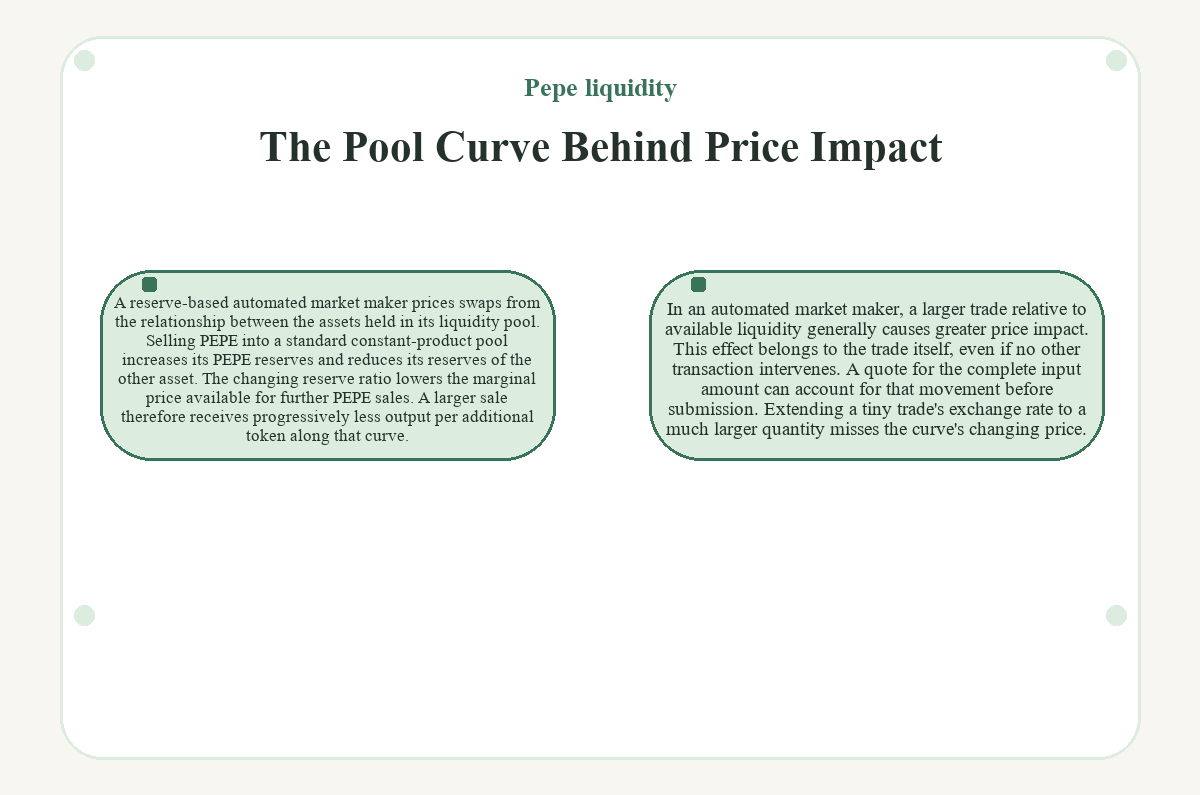
In an automated market maker, a larger trade relative to available liquidity generally causes greater price impact. This effect belongs to the trade itself, even if no other transaction intervenes. A quote for the complete input amount can account for that movement before submission. Extending a tiny trade's exchange rate to a much larger quantity misses the curve's changing price.
Trading Volume and Token Valuation
Trading volume measures completed activity over a stated period, while depth measures capacity available at particular prices. Repeated trades can generate substantial volume against relatively limited standing liquidity. A combined PEPE volume figure also spans markets that a particular order may never reach. Activity helps describe a market's history, but the current book or applicable pool determines the next trade's execution.
Market capitalization multiplies a reference token price by circulating supply. That valuation does not represent funds reserved to purchase every holder's PEPE.
Tokenomics describes supply and distribution, which influence how much PEPE holders could offer for sale. It does not specify how much demand awaits that supply at an acceptable price. The price impact of selling a large holding depends on available bids and pool depth, regardless of its owner's intentions.
Reserve Liquidity and Active Price Ranges
Full-Range Reserves
A full-range constant-product pool distributes liquidity along its price curve. Both reserve balances matter to a PEPE sale: the token balance helps determine the exchange ratio, and the other reserve supplies output. Total pool value can combine both assets, so it is not an amount available entirely as sale proceeds.
Concentrated Price Ranges
A concentrated-liquidity position contributes active liquidity only while the trading price lies within its selected range. Where a PEPE market uses this model, funds outside the present range do not provide depth at that price. Larger swaps can cross range boundaries, where active liquidity changes. A pool's total assets therefore need not describe the liquidity available throughout the proposed trade.
Fees Within the Execution Cost
Execution cost combines the price obtained with explicit charges, and each quote needs a clear treatment of those charges.
Trading Fees
The fee that a pool charges depends on its protocol version and fee configuration. Exchange orders have their own fee schedules. Comparing nominal fees alone misses differences in depth: a lower-fee market can deliver less output if its price impact is larger. The relevant comparison uses the same PEPE quantity and receiving asset.
Ethereum Gas
An Ethereum swap also consumes gas, the network's measure of computational work. Transaction complexity and the applicable gas price determine this separate cost. Any required spending approval can add another transaction charge. Gas does not purchase liquidity or replenish pool reserves. Its cost can remain payable when an included transaction reverts, because the network already performed computational work.
Net Quote Accounting
A quote may already deduct a trading fee from expected output while showing network costs separately. Subtracting an included fee again understates proceeds. Comparing costs paid in different assets also requires a consistent valuation basis; otherwise an apparent execution advantage may reflect mismatched units.
Price Controls and Execution Certainty
Limit Orders
A sell limit permits fills at its specified price or better. It can leave some or all PEPE unsold when buyers do not offer enough at that level. A market order seeks available liquidity immediately, potentially consuming multiple price levels. Venue-specific protections may stop execution before the entire quantity fills.
Minimum Swap Output
A minimum-output check rejects a compatible swap when its received amount falls below the specified floor. Slippage describes a change between the quoted terms and execution. A wider tolerance permits a worse outcome; it does not add reserves or remove the price impact already reflected in a quote. Tight bounds can produce more failed executions when market conditions change.
Trade Splitting and Accessible Routes
Trade splitting changes how much liquidity each execution consumes, while routing changes which pools supply that liquidity. Smaller orders over time may encounter replenished bids or reserves, reducing immediate impact. That benefit requires replenishment or other favorable changes. Dividing a sale against unchanged liquidity does not automatically avoid the cumulative movement along the same pool curve.
Waiting between trades introduces exposure to changing prices. Repeated on-chain transactions can also increase total network costs.
Where supported, routing software can distribute a swap across multiple pools or use intermediate assets. This may access additional depth, with fees and computational costs affecting the final output. A route is useful only if its constituent markets support the intended exchange. Combined liquidity across unrelated venues is not automatically available to one order.
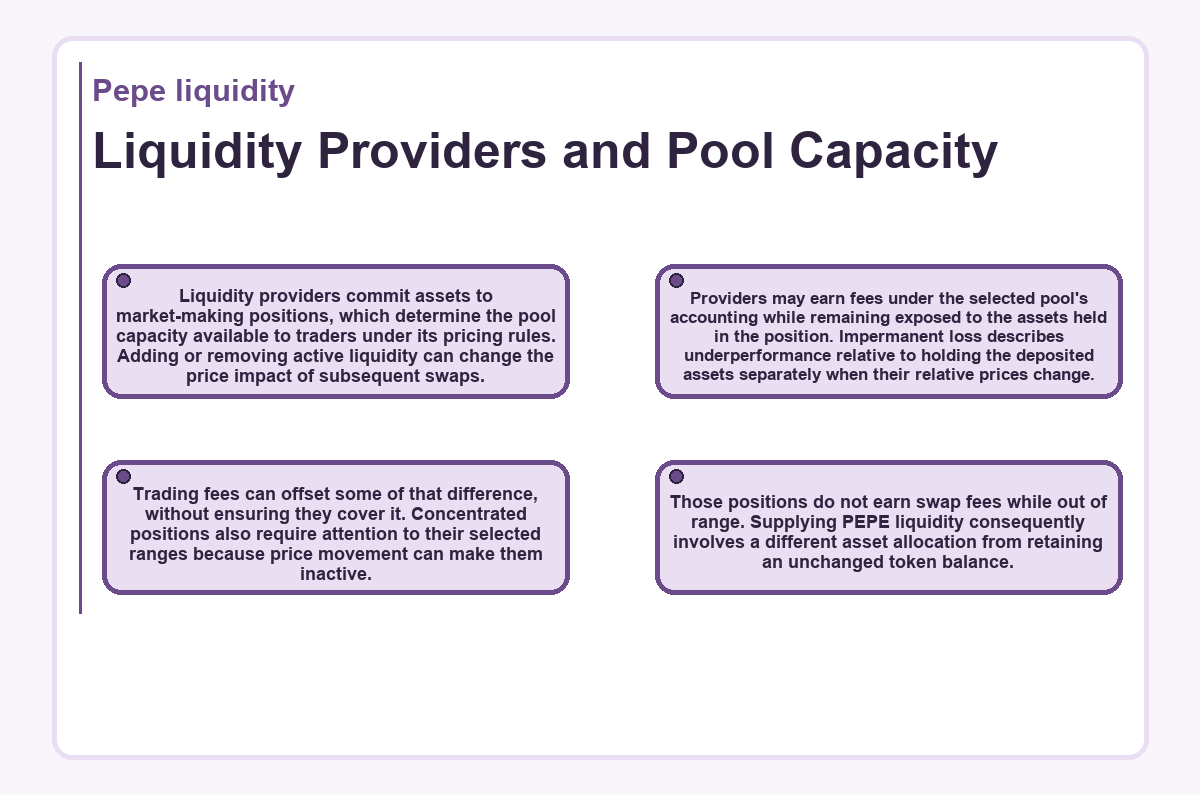
Liquidity Providers and Pool Capacity
Liquidity providers commit assets to market-making positions, which determine the pool capacity available to traders under its pricing rules. Adding or removing active liquidity can change the price impact of subsequent swaps. Providers may earn fees under the selected pool's accounting while remaining exposed to the assets held in the position.
Impermanent loss describes underperformance relative to holding the deposited assets separately when their relative prices change. Trading fees can offset some of that difference, without ensuring they cover it. Concentrated positions also require attention to their selected ranges because price movement can make them inactive. Those positions do not earn swap fees while out of range. Supplying PEPE liquidity consequently involves a different asset allocation from retaining an unchanged token balance.
Thin Markets and Pending Swap Exposure
Thin PEPE depth can deteriorate during heavy selling as orders consume bids or swaps change pool balances. Standing orders may also disappear through cancellation. A displayed liquidity snapshot does not commit every participant to keep offering the same capacity through submission and execution.
Insufficient output can prevent a swap from meeting its minimum, even when the pool still contains tokens. Separately, an interface may lack a usable route between the selected assets. Relaxing a price bound cannot create a missing route or resolve every transaction failure.
A publicly visible pending swap can expose its direction and size to searchers. In a sandwich attack, surrounding transactions move the pool price against the swap and then unwind the attacker's trade. Wider permissible slippage can leave more room for adverse execution. A minimum-output floor limits acceptable output deterioration within its scope; it does not establish complete protection against transaction-ordering strategies.
A reverted swap undoes its token-transfer changes, while a partially filled exchange order retains completed fills. These outcomes leave different quantities unsold and require different readings of the execution record.
Fill Records and Changing Liquidity Conditions
Execution records distinguish the quantity actually traded from the quantity originally requested, preventing partial fills from masquerading as complete sales. Exchange fill records provide executed amounts, prices, and fees. A successful on-chain swap has transaction and token-movement records that establish the asset amounts delivered. A quote, signature, or pending transaction identifies an earlier stage and cannot establish final proceeds.
Ongoing liquidity monitoring concerns the market used for the next trade. Changes in spreads, cumulative depth, active ranges, and route availability can invalidate an earlier estimate. Records from a completed trade remain historical even when later conditions differ. For a PEPE sale, the comparable execution figure is net proceeds per token actually sold.
FAQ
Can a PEPE Depth Chart Omit Part of an Order's Quantity?
A PEPE depth chart may omit hidden order size where the venue supports iceberg orders. An iceberg order displays only part of its total quantity and can expose more as that portion fills. Visible depth therefore describes displayed quantities within the chart's price range. Hidden interest also does not commit to absorbing an arbitrary sale quantity.
Can a PEPE Limit Order Be Charged a Taker Fee?
A PEPE limit order can incur taker fees when it immediately matches existing orders on a venue with maker-taker pricing. The limit controls the permitted execution price, while maker or taker status concerns whether the filled portion provided resting liquidity before execution or consumed an existing order on arrival. Different portions of one order can receive different fee treatment. Where supported, post-only instructions prevent immediate taker execution.
Would Locking a PEPE Pool Guarantee the Price of a Later Sale?
Locking liquidity withdrawal rights does not guarantee a future PEPE execution price. A lock can restrict removal of a particular position without freezing swaps, reserve ratios, or sales by other holders. Its protection also concerns the covered position, not every market trading PEPE. Price impact remains relevant whenever a sale consumes available liquidity, regardless of whether someone can withdraw that position.
How Can a PEPE pool's Reported Value Rise Without New Deposits?
A PEPE pool's reported monetary value can rise when the assets already in it receive higher valuation prices. Such a measure combines token balances with reference prices. Even if those balances remain unchanged, a higher valuation can increase the displayed total. That change alone does not establish additional token reserves or a larger amount available for a sale in the receiving asset.
What Does Being Exit Liquidity Mean When Buying PEPE?
Being exit liquidity means supplying buying demand that enables existing PEPE holders to sell. A purchase can supply that demand without revealing the seller's identity, acquisition cost, or intentions. The label alone establishes neither coordinated misconduct nor the buyer's eventual gain or loss. The execution question remains whether available buying interest can absorb sales at the prices and quantities being offered.
Will Canceling a Partially Filled PEPE Order Undo Its Completed Trades?
Canceling a partially filled PEPE order affects its unfilled remainder and does not reverse completed fills. Tokens already sold remain sold, and the proceeds and applicable fees from those executions remain part of the account record. After cancellation is confirmed, subtract the cumulative filled quantity from the requested quantity to find how much of that order remains unsold. A cancellation request alone does not show that the venue has finished processing the cancellation.
Does an exchange's PEPE Wallet Balance Equal Its sell-side Order Depth?
An exchange's PEPE custody balance and its sell-side order depth measure different quantities. Custody can include tokens whose owners have not offered them for sale. Order depth concerns offers posted at particular prices, with funds reserved under the venue's rules. A blockchain wallet balance alone cannot reveal that complete matching state, so it does not establish how much PEPE is immediately available in the order book.