 Pepe
Pepe
Pepe Token Approvals and the Limits of Revoking Access
Pepe holders can set a spender's allowance to zero to remove its permission to withdraw PEPE from their Ethereum wallet. Revocation takes effect when the token contract successfully processes the transaction. It blocks later allowance-based spending through that address without undoing completed transfers. Other spenders and access through a stolen private key require separate attention.
An approval resembles a spending ceiling attached to a particular address. Keeping a smaller ceiling and removing access entirely serve different needs. A trading application's request for continuing permission therefore involves both convenience and exposure of the tokens that remain in your wallet.
Key takeaway: A successful revocation removes the selected spender's allowance without moving the PEPE that remains in your wallet.
PEPE Spending Limits by Spender
A token allowance records how much
PEPE
a particular spender may take from a particular holder through the token contract. The allowance and wallet balance are separate values. Permission to spend does not reserve tokens, move them into custody, or prove that a swap occurred. A spender using
transferFrom
needs sufficient allowance and a sufficient balance for the transfer. The spender also differs from the recipient: an authorized contract may direct tokens to another address as its code allows. Each owner-spender pair has its own allowance within that token contract. Removing access for one trading contract leaves other spenders' allowances unchanged.
A website's name does not identify this permission precisely enough, because an application may use several contract addresses. The address that actually holds the allowance determines which permission an adjustment changes.
Can I Reduce a PEPE Allowance Without Revoking It?
You can retain limited spending permission by setting a smaller positive allowance or using the PEPE contract's
decreaseAllowance
function. An
approve
call specifies the replacement limit, while
decreaseAllowance
subtracts a chosen amount from the allowance that exists when the call executes. The token also exposes
increaseAllowance
for adding to the existing limit. An interface may offer fewer controls than the contract itself supports.
A reduction fails if its subtraction exceeds the remaining allowance. Spending that occurs before execution can therefore make a previously calculated reduction too large. A successful reduction to a positive value still permits spending up to that value, subject to the available balance and transfer rules. Keeping access suits an intended future interaction; removing it addresses a spender that has no remaining task.
Replacement Allowances and Transaction Ordering
Replacing an existing positive allowance requires attention to transactions that can execute before the replacement, especially when the spender already has access.
The ERC-20
approve
function replaces the existing allowance with the amount specified in the new call.
A spender might use the old permission before that update and the new permission afterward. A smaller replacement limit consequently does not cap the combined amount spent across both states.
The zero-first approach removes the existing allowance before establishing another positive limit. In this approach, confirmation of the reset comes before the new approval. This addresses the replacement race without recovering tokens that left before the reset. When the intended outcome is simply to remove access,
approve(spender, 0)
sets the allowance directly to zero without calculating a subtraction from an earlier reading.
Exact Approvals, Large Limits, and Direct Transfers
An approval limited to the intended spending amount bounds the permission granted for a transaction, while a large allowance accommodates repeated use. The convenience of a large limit comes from needing fewer future allowance updates and their associated gas payments. An allowance-based PEPE transfer reduces the stored allowance by the amount transferred. Its remaining permission can also cover tokens received later. An exact cap may leave residual access if an application spends less than the approved amount.
A direct PEPE transfer uses the holder's own authority to send tokens to a recipient and does not require a spender allowance. A contract-based swap may need permission to pull tokens as part of its execution. Sending tokens to an application contract alone does not establish that its swap logic will run. The application's supported transaction design determines which authorization it needs.
Gas Costs for Ethereum Approval Changes
A conventional allowance-changing transaction sent from an Ethereum account pays its network fee in ETH. The charge does not scale directly with the number of PEPE tokens covered by the allowance. Gas used and the effective price per gas determine the network fee. An interface's estimate applies to a proposed transaction under particular network conditions.
An Ethereum transaction that reverts during contract execution still incurs a gas fee. Rejection before on-chain execution is a different state. A failed allowance change leaves the earlier permission intact. Setting a limit to zero and granting a new positive limit through separate transactions also creates separate gas costs.
When Does a PEPE Revocation Take Effect?
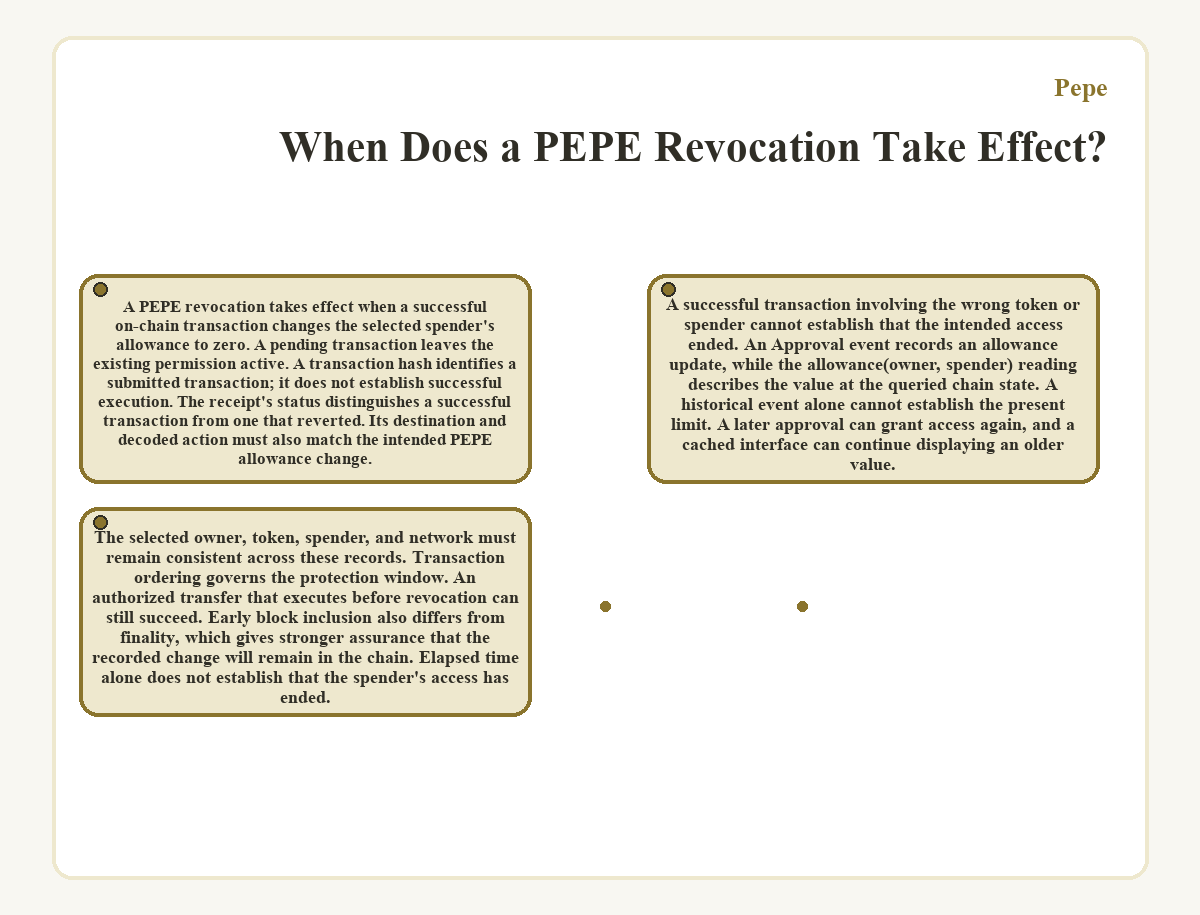
A PEPE revocation takes effect when a successful on-chain transaction changes the selected spender's allowance to zero. A pending transaction leaves the existing permission active.
A transaction hash identifies a submitted transaction; it does not establish successful execution. The receipt's status distinguishes a successful transaction from one that reverted. Its destination and decoded action must also match the intended PEPE allowance change. A successful transaction involving the wrong token or spender cannot establish that the intended access ended.
An
Approval
event records an allowance update, while the
allowance(owner, spender)
reading describes the value at the queried chain state. A historical event alone cannot establish the present limit. A later approval can grant access again, and a cached interface can continue displaying an older value. The selected owner, token, spender, and network must remain consistent across these records.
Transaction ordering governs the protection window. An authorized transfer that executes before revocation can still succeed. Early block inclusion also differs from finality, which gives stronger assurance that the recorded change will remain in the chain. Elapsed time alone does not establish that the spender's access has ended.
Completed Transfers and Existing Liquidity Positions
Revocation changes future withdrawal permission and leaves completed PEPE transfers, executed swaps, and their economic outcomes in place. It does not refund a transaction fee or restore an earlier trading price. A finalized transfer remains part of the transaction history. Even an unwanted transfer that used a valid allowance cannot be undone by changing that allowance afterward.
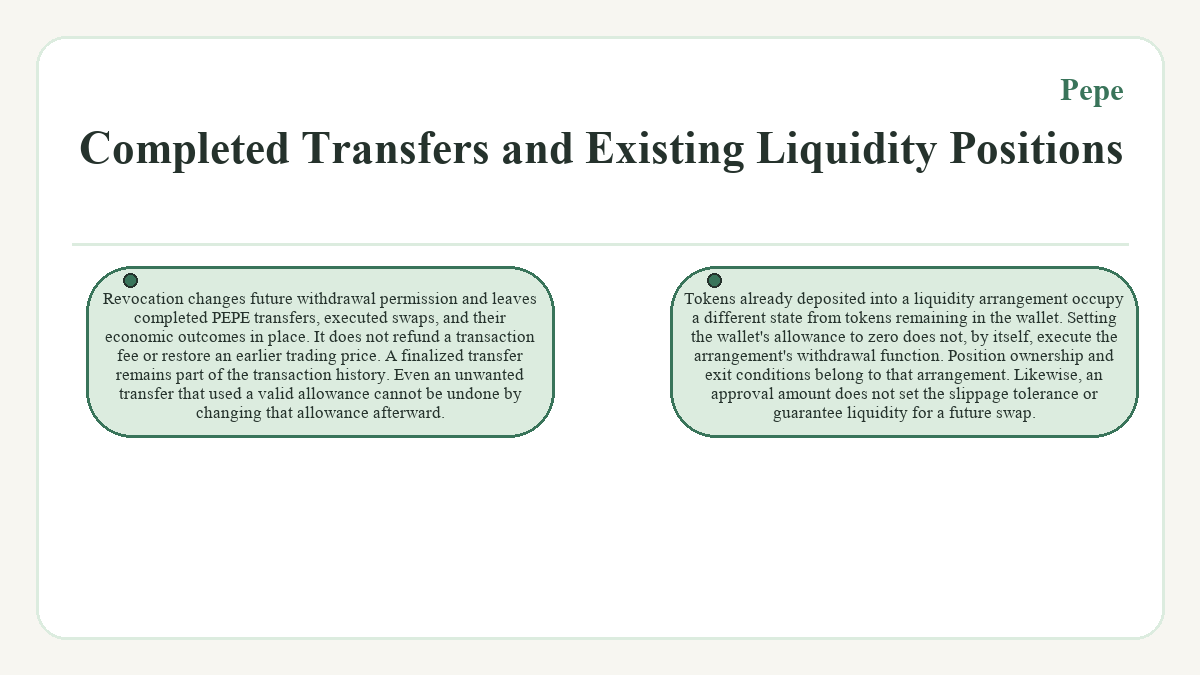
Tokens already deposited into a liquidity arrangement occupy a different state from tokens remaining in the wallet. Setting the wallet's allowance to zero does not, by itself, execute the arrangement's withdrawal function. Position ownership and exit conditions belong to that arrangement. Likewise, an approval amount does not set the slippage tolerance or guarantee liquidity for a future swap.
Wallet Connections and Persistent Permissions
Closing a trading website or ending its wallet connection affects the browser session, while the token contract retains its allowance records. Disconnecting a wallet from a website does not change the PEPE allowances stored on Ethereum. PEPE's token-level allowance has no built-in expiry date. Time away from an application therefore does not, by itself, terminate its permission.
An empty PEPE balance also leaves a remaining allowance in place. Newly received tokens can become spendable through that allowance, up to the permitted amount. A direct transfer out of the wallet changes the balance without deleting these permissions. Allowances on another network or another token contract are separate records, even when an interface displays similar names and the same wallet address.
Revocation Checks for an Unused Spender
Assume a trading spender no longer has an intended use, but still holds a positive PEPE allowance. Removing its access requires an Ethereum transaction whose cost follows gas usage and network fees. The wallet's token balance does not determine the gas charge.
- Match the Ethereum account and PEPE contract to the allowance under review.
- Choose zero as the replacement amount if that spender has no remaining task.
- Check that the transaction requests an allowance change for the intended spender, and that the account can cover gas.
- Confirm that the revocation transaction succeeded and that the current allowance is zero for the same owner and spender.
- Treat a later positive approval as renewed access, even if the earlier revocation succeeded.
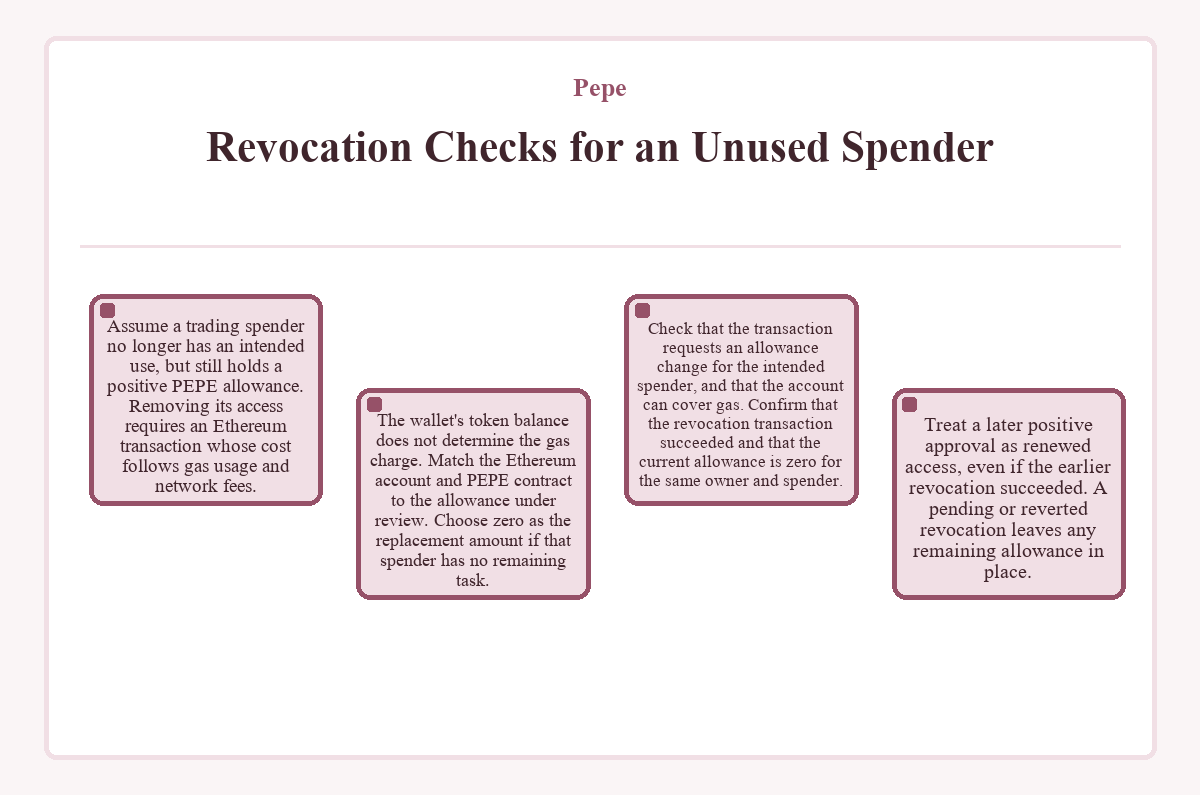
A pending or reverted revocation leaves any remaining allowance in place.
Compromised Keys and Public Approval Records
Someone who controls the private key of an ordinary Ethereum account can authorize direct transfers or grant fresh allowances despite an earlier revocation.
Removing one spender's permission addresses that allowance, while a compromised account presents a wider control problem. An external revocation service does not need your recovery phrase or private key; the wallet authorizes the transaction.
Approval events and revocation transactions leave public records linking the holder's address to a spender. Setting an allowance to zero does not erase earlier interactions or conceal the wallet's transaction history. Sharing the address for an allowance check also gives the recipient enough information to inspect that public history.
Frequently asked questions
Does Receiving PEPE Require a Spending Approval?
Receiving a normal PEPE transfer does not require the recipient to grant a spending allowance. An approval authorizes a spender to take tokens from the account granting it. A transfer to your address increases your balance, subject to the token's transfer rules. A request to approve spending is therefore a separate permission, even when a website describes it as part of receiving tokens.
Can I Revoke an Allowance With a Different Wallet App?
A compatible wallet app can submit a PEPE revocation if it can authorize transactions from the account that granted the allowance. Permissions belong to that Ethereum address, rather than to the application's name. Creating a new wallet with a different address does not give it control over the old account's allowances.
Will a Failed Swap Clear an Earlier PEPE Approval?
A failed swap does not clear a PEPE approval that succeeded in a separate, earlier transaction. Reverting the swap undoes changes within that swap transaction, while the earlier approval remains stored. If approval and swap both occur inside one transaction that fully reverts, neither state change persists. The transaction boundary determines which changes survive.
How Do I Read a PEPE Allowance Shown in Raw Units?
PEPE uses 18 decimal places, so a raw allowance divided by 10^18 gives the amount in displayed token units. Some interfaces show the integer returned by the contract, while others scale it into PEPE units. Those representations can look very different for the same stored value. Establish which representation the field uses before editing an amount.
Is Setting the Spender to the Zero Address a Valid Revocation?
PEPE rejects an approval whose spender is the zero address. Revocation retains the address that already holds permission and sets its allowance amount to zero. The spender address and approved amount are different inputs. Replacing the spender with an empty or zero address does not cancel the existing owner-spender allowance.