 Pepe
Pepe
Pepe tokenomics combines a no-presale launch with separate liquidity and reserve allocations
Pepe tokenomics describes how PEPE's original supply was created, allocated, and made available for trading without a presale. The launch allocation sent approximately 93.1% to a liquidity pool and reserved 6.9% in a multisignature wallet. Those percentages describe the original distribution, while later transfers and burns affect how existing tokens are held or counted.
What's inside
A pool balance, a reserve wallet balance, and the contract's total supply measure different things. Transfers move existing PEPE between accounts, while a burn can reduce contract supply or remove tokens from trading, depending on the method.
Liquidity Enabled Trading While the Reserve Was Set Aside for Listings
The liquidity allocation supported public trading, while the reserve held PEPE for exchange listings, bridges, and additional pools. A liquidity pool contains assets that traders exchange against one another. Its PEPE balance therefore changes as swaps move tokens between the pool and trading wallets. The launch percentage does not specify how much remains there today.
The remaining allocation gave the reserve's signers control over tokens that already existed. Moving those tokens later can change their availability for trading without creating additional supply. A reserve allocation for future listings or bridges describes an intended use of existing tokens; it does not establish that a particular exchange or bridge supports PEPE or that a deployment has occurred. An open trading pool provides a way to acquire tokens; it does not give each participant an equal balance.
How Can You Confirm a PEPE Reserve Transfer?
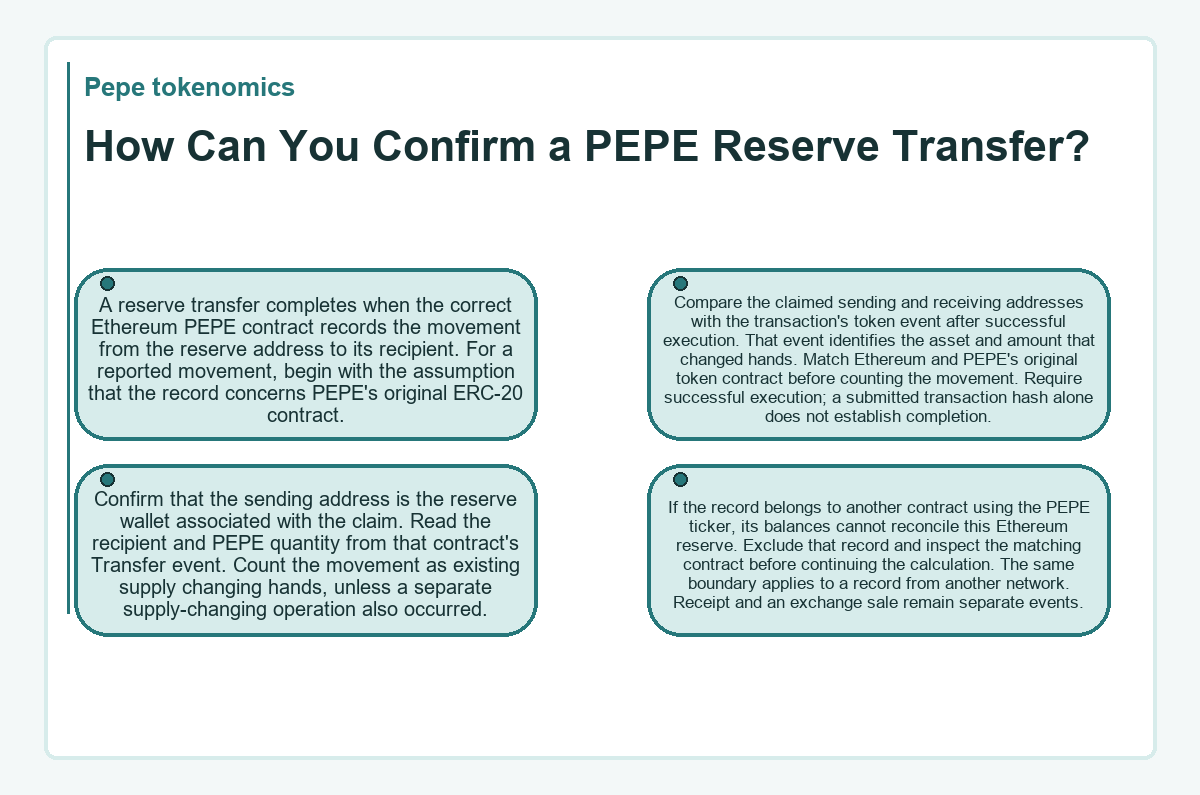
A reserve transfer completes when the correct Ethereum PEPE contract records the movement from the reserve address to its recipient. For a reported movement, begin with the assumption that the record concerns PEPE's original ERC-20 contract. Compare the claimed sending and receiving addresses with the transaction's token event after successful execution. That event identifies the asset and amount that changed hands.
- Match Ethereum and PEPE's original token contract before counting the movement.
- Require successful execution; a submitted transaction hash alone does not establish completion.
- Confirm that the sending address is the reserve wallet associated with the claim.
- Read the recipient and PEPE quantity from that contract's Transfer event.
- Count the movement as existing supply changing hands, unless a separate supply-changing operation also occurred.
If the record belongs to another contract using the PEPE ticker, its balances cannot reconcile this Ethereum reserve. Exclude that record and inspect the matching contract before continuing the calculation. The same boundary applies to a record from another network. Receipt and an exchange sale remain separate events.
Deployment Set the Issuance Ceiling
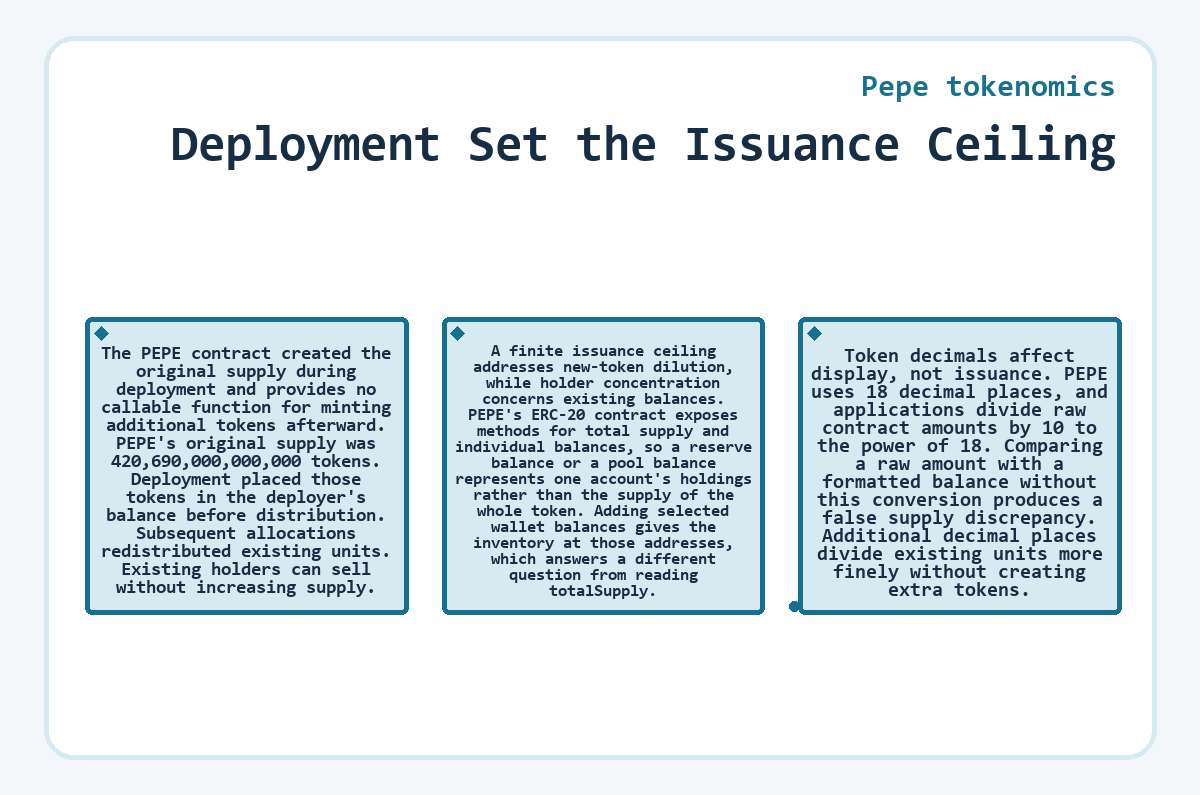
The PEPE contract created the original supply during deployment and provides no callable function for minting additional tokens afterward. PEPE's original supply was 420,690,000,000,000 tokens. Deployment placed those tokens in the deployer's balance before distribution. Subsequent allocations redistributed existing units.
Existing holders can sell without increasing supply. A finite issuance ceiling addresses new-token dilution, while holder concentration concerns existing balances.
PEPE's ERC-20 contract exposes methods for total supply and individual balances, so a reserve balance or a pool balance represents one account's holdings rather than the supply of the whole token. Adding selected wallet balances gives the inventory at those addresses, which answers a different question from reading totalSupply.
Token decimals affect display, not issuance. PEPE uses 18 decimal places, and applications divide raw contract amounts by 10 to the power of 18. Comparing a raw amount with a formatted balance without this conversion produces a false supply discrepancy. Additional decimal places divide existing units more finely without creating extra tokens.
Reserve History Separates Wallet Control From Contract Control
PEPE's renounced contract ownership and its reserve wallet govern different permissions, so relinquishing one does not remove control over the other. A multisignature wallet authorizes movements through its configured signing rules. The required signature threshold concerns spending reserve assets; it does not determine the token's total supply.
In August 2023, team members moved approximately 16 trillion PEPE from the reserve wallet to exchanges. Renouncing the token contract had left the reserve under separate wallet control.
In October 2023, 6.9 trillion PEPE from the reserve moved to a burn address. This historical amount is separate from the 6.9% launch reserve allocation. A trillion-token quantity and a percentage of initial supply are different units, even when their displayed numbers resemble each other.
The original reserve percentage therefore cannot stand in for its remaining balance. Later movements matter, as do changes to its signing configuration. Renunciation removes the owner's access to privileged token settings. It does not destroy the keys that authorize a separate reserve wallet, or require every holder's permission before that wallet moves tokens.
Burned LP Tokens Restrict Liquidity Withdrawal
Sending the launch liquidity-provider tokens to an inaccessible address removed access to the withdrawal rights that those tokens represented. PEPE and LP tokens are separate assets. The underlying pool remains available for swaps, so its PEPE reserves can change. This disposal differs from ordinary LP redemption, which burns LP tokens while returning underlying assets. Providers who add liquidity later receive separate positions with their own withdrawal rights.
PEPE Burn Methods Change Different Supply Measures
A successful call to PEPE's burn function reduces the caller's balance and total supply; inaccessible-address transfers use different accounting. The callable burn destroys units and emits a token transfer event to the zero address. A normal transfer to a nonzero burn address leaves those units in that address's balance. It does not reduce the contract's totalSupply value.
A circulating-supply service may exclude balances that it classifies as permanently inaccessible. Another display may show the contract's total, making the figures different without any additional issuance. Supply comparisons need the same definition and observation point. Subtracting a burn-address balance from a figure that already excludes it would double-count the reduction.
Ordinary PEPE transfers do not automatically burn a fraction of each transfer. A separate burn operation or destination determines the supply effect.
Supply and Fees Shape PEPE's Trading Economics
PEPE's zero-tax design leaves Ethereum gas costs and venue charges outside the token's own transfer mechanics. The contract does not deduct a project tax from each PEPE transfer. Ethereum transactions still consume gas, paid in ETH, and a trading venue may charge its own fees. These charges depend on the transaction and market, so zero token tax does not make every PEPE trade free.
Valuation requires a price and a matching supply measure. Market capitalization multiplies token price by circulating supply. PEPE's large original unit count helps explain a small quoted price per token; the cost of acquiring many units still follows their combined market value. A supply ceiling controls one input without fixing demand or the price at which holders can sell.
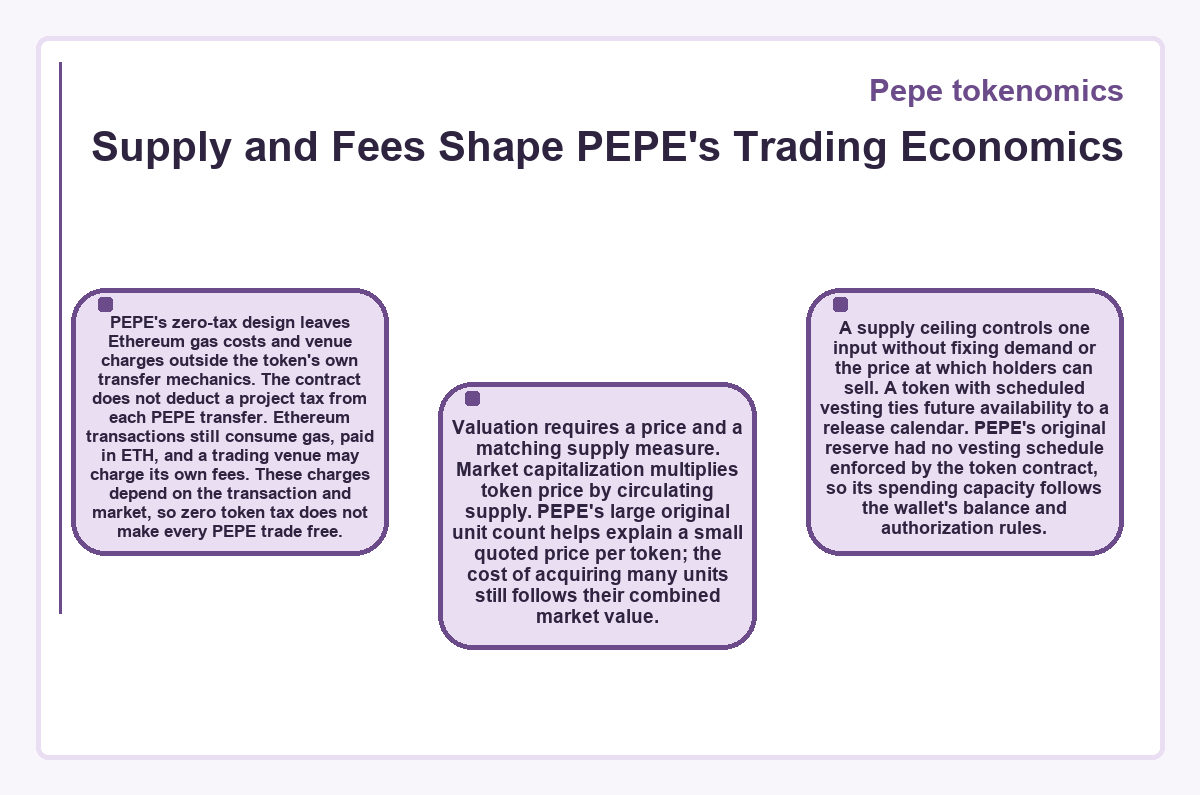
A token with scheduled vesting ties future availability to a release calendar. PEPE's original reserve had no vesting schedule enforced by the token contract, so its spending capacity follows the wallet's balance and authorization rules.
Pepe tokenomics: reader questions
Does Holding PEPE Give Me a Share of the Reserve?
Holding PEPE does not give you an automatic claim on the reserve wallet's tokens. The token contract records ownership of your units and contains no reserve-redemption mechanism that distributes the reserve in proportion to holders' balances. A purpose such as funding listings identifies what the reserve was intended for; it does not convert every PEPE balance into a redeemable share.
Can PEPE Balances Grow Automatically Through Reflection Rewards?
PEPE's original Ethereum contract does not automatically increase holder balances through reflection rewards. Reflection mechanisms redistribute tokens to holders, often through transfer taxes. PEPE's transfers move recorded units between accounts without that redistribution. A balance increase needs another explanation, such as a received transfer. An external rewards offer has separate rules and cannot be inferred from PEPE's launch allocation.
Is There a Monthly Unlock Schedule for the Original PEPE Reserve?
The PEPE token contract does not enforce a monthly unlock schedule for the original reserve. Those reserve tokens formed part of the supply created at launch. Their movement follows wallet authorization. A reserve transfer can still increase the amount available at a trading venue without creating new PEPE. An announced spending plan differs from a lock that the token contract enforces.
Which Supply Measure Belongs in a PEPE Ownership Percentage?
A PEPE ownership percentage requires a stated denominator, such as contract total supply or a defined circulating supply. Divide the relevant token balance by that supply measure, then multiply by 100. Excluding burn-address balances produces a different percentage from using the full contract total. Comparisons require the balance and denominator to concern the same token and observation point.
Are Transaction Fees From a PEPE Pool Paid to Every Token Holder?
Liquidity providers' share of swap fees accrues to eligible liquidity positions, without automatically going to everyone holding PEPE. Owning PEPE and owning LP tokens are separate positions. Holding the relevant liquidity-provider position determines participation in that pool's fee economics. Burning the launch LP tokens creates no fee-sharing claim for PEPE wallets. Later liquidity providers hold their own positions under the particular pool's rules.